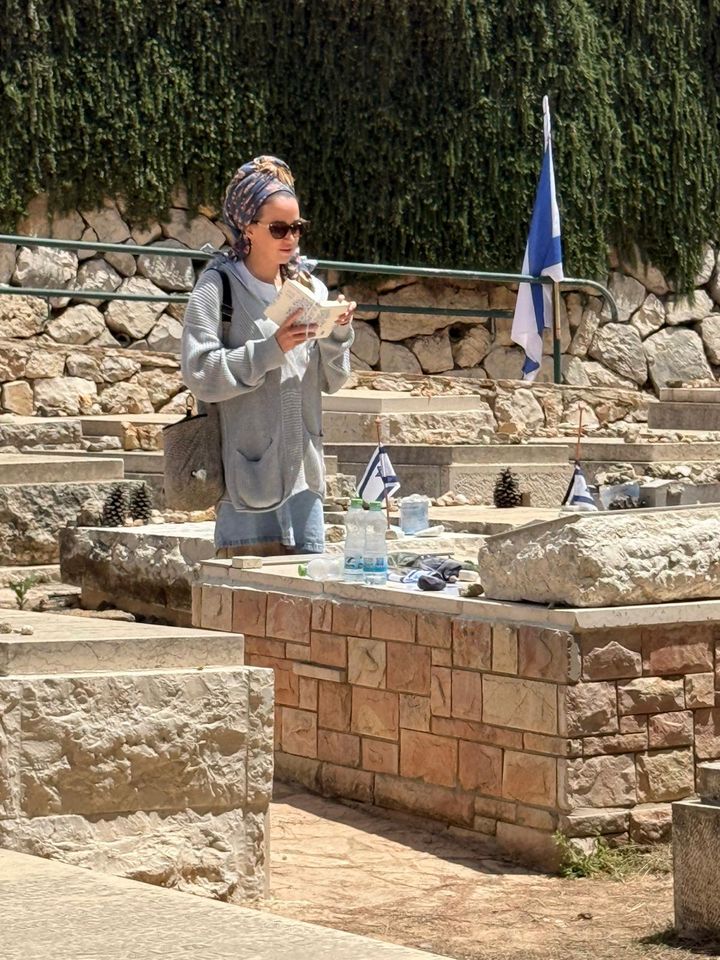
Jerusalem, Israel - Apr. 21, 2026 - As I sit here in the Gush Etzion cemetery, beside the graves of Ari Fuld, Lucy Dee, and 17 newly fallen soldiers from this war—along with so many other victims of terror—I’m trying to put into words what feels almost impossible to express.
Hundreds of people are around us, swaying in song and prayer. The emotion here isn’t abstract. It’s heavy. It’s alive.
I grew up in Baltimore, where Yom Hazikaron was something distant—“a sad day in Israel.” I tried to connect to it, but the truth is, unless you’re here, you can’t fully understand it.
The closest way to describe it is this: it’s a national shiva.
Minister of Finance Betzalel Smotrich at the grave of Ari Fuld
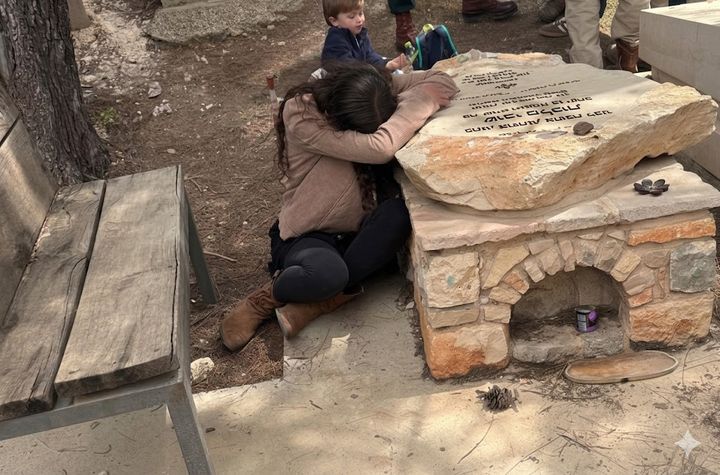
An entire country pauses. People gather in cemeteries, in homes, at ceremonies. Everywhere you go, you feel it. We come together to hold the families who carry unbearable loss—not just today, but every day. For 24 hours, we stand with them. We sing with them. We cry with them.
It is a day that is at once heartbreaking, holy, and somehow comforting.
The deepest sadness, alongside an overwhelming pride to be part of this nation—both existing together in a way that’s hard to explain.
It feels like Yom Kippur and Tisha B’Av wrapped into one uniquely Israeli experience.
A few things hit me deeply today.
First—how many people around us carry pain we cannot see. People we interact with every day are holding losses we may never fully understand. Today, we all stop and share that weight together.
Second—give people the benefit of the doubt. You truly don’t know what someone else is carrying.
Last night, as the siren sounded to open Yom Hazikaron, a woman standing in front of us collapsed into sobbing. It wasn’t quiet—it pierced through everyone there.
Later we learned her son was killed fighting in Gaza.
That moment stays with you.
As a nation, we are exhausted. The past two and a half years have taken a toll. And yet—watching the younger generation stand together, singing through tears, gives real hope. There is strength here. There is resilience.
And then comes the transition that only Israel knows how to make.
Even as I write this, messages are coming in on my phone about tomorrow’s musical Hallel—about coming together to give thanks for a state that continues to survive and thrive through what feels like daily miracles.
That’s who we are.
Today we cry together.
Tonight we gather for a bbq and make a L’Chaim together.
Tomorrow we give thanks together.
Different emotions, back to back—but one constant:
I believe that these days are our people’s “secret sauce.”
We are one people. One family.
As I was leaving the cemetery, I found myself wondering where Leo Dee and his children were—the family of Lucy, Maia Dee, and Rina Dee.
I thought maybe it was simply too painful for them to be there with the large crowds
On the drive home, I got my answer.
The national ceremony was playing live on the radio. They called upon Rabbi Leo Dee to recite Kaddish—for the entire nation to hear.
Kaddish, the central Jewish prayer sanctifying God’s name, doesn’t mention death at all. Instead, it affirms faith, praises God’s greatness, and prays for peace—even in the depths of grief.
That’s who we are as a nation.
The video above is incredibly powerful. It was filmed at Mount Herzl during the official national ceremony. You hear Hatikvah being sung, followed by the formal announcement that the ceremony has ended. But then—something remarkable happens. The crowd doesn’t disperse. Instead, people begin singing together, spontaneously—Ani Ma’amin. “I believe with complete faith in the coming of the Messiah…” In that moment, you feel it. Not just mourning—but unity, faith, and a deep national longing for something better and bigger
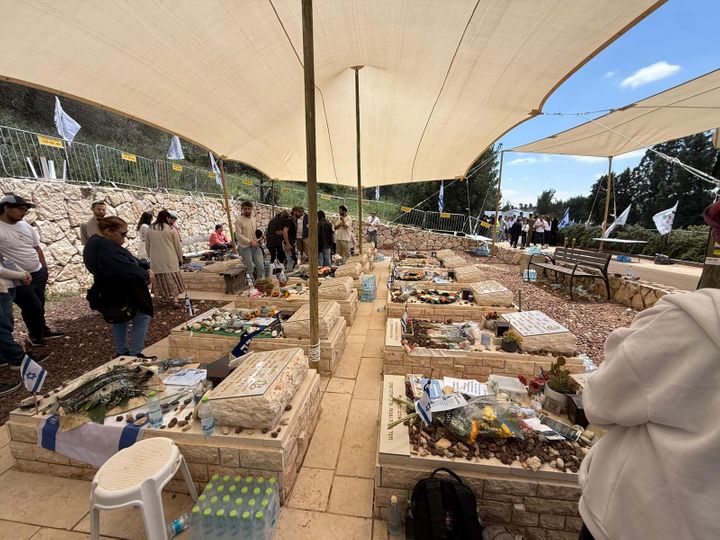
The 17 new graves of soldiers who fell during the current war.