This week it was revealed that the Guinness World Records organization is boycotting Israel. The nonprofit Matnat Chaim (Gift of Life) contacted Guinness headquarters requesting to register a record of 2,000 kidney donors, and received a rejection due to the company’s policy toward Israel and the war.
One could certainly argue that this itself breaks a Guinness record … for hypocrisy! One could also marvel at the very achievement Israel sought to register, not the world’s heaviest man, not the person with the longest mustache, but a record of kindness and solidarity.
The rejection, which Israel’s Foreign Ministry is working to overturn, was received by Matnat Chaim just as they concluded a celebratory Shabbat. It turns out that since the war began, two things happened: the organization stopped holding its traditional Shabbatons honoring kidney donors, and, unexpectedly, the number of donors continued to rise.
Now, the Shabbatons are being renewed. And because there has been a record number of more than 100 donors in the past two years, two additional Shabbatons will be held in order to accommodate everyone.
The stories are especially moving: evacuees from Israel’s north and south who decided to donate; soldiers who came straight from the front lines to donate a kidney; and a range of individuals who felt moved by current events to give. The religious and chareidi sectors have always been the overwhelming majority of donors—in some years 99%—but recently we have seen a rise in donors from the secular and traditional public as well.
But what does this mean for the rest of us?
The magnet that participants received at the end of the Shabbat gathering included an important quote from the organization’s founder, Rabbi Yeshayahu Haber z”l: “Not everyone can donate a kidney, but everyone can donate something: a generous eye, attention, a listening ear, encouragement, a kind word.”
Wishing all a meaningful day of giving.
Sefer Torah at Rabin High School
Two days after the October 7 massacre, Dani Alush, a devoted employee of the Israel Electric Company, went to repair power lines near the Avshalom junction in southern Israel. In the chaos that ensued, he was tragically killed by IDF fire.
“Dani went there to restore light, and his light will never be extinguished,” his family said. His wife, Gal, who serves as vice principal at Rabin High School in Be’er Sheva, decided to commemorate him in the place closest to her heart: by dedicating a Sefer Torah in his memory for the school.
Last week, the streets of Be’er Sheva filled with dancing and singing as crowds accompanied the new Sefer Torah to the school. At the dedication ceremony, Gal shared these words:
“Tonight my soul is happy. This is the first time since Dani was killed that I’ve felt genuine happiness. I didn’t think I would ever feel this way again, but that is how I felt tonight. Thank you.”
Hundreds of people broke into applause. Among them was the mayor of Be’er Sheva, Ruvik Danilovich, who said that Dani had been a personal friend and that he misses him every day.
Gal went on to explain:
“The decision to honor Dani’s memory through writing a Sefer Torah came naturally to us. The second decision, to give the Sefer Torah to a non-religious school instead of a synagogue, was less obvious, but for me it was very clear, for two reasons.
“First, knowing that Dani’s Sefer Torah will be close to me every day, and that I can hear it being read, brings me deep comfort.
“Second, and no less important, bringing a Sefer Torah into a secular school is, to me, even more moving and holy than donating it to a religious school or synagogue. In those places, a Sefer Torah is expected. Here, in a secular school where students can hear its words and read from it, the act feels many times more sacred and heartwarming.”
We are living in a new Jewish era. At Rabin High School, students have already read from their new Sefer Torah about our forefather Yaakov and the timeless lessons he passed on to his children and to all future generations, including us.
Parashat Vayeishev: What is success?
Yosef HaTzadik is the only one in the entire Torah who is called an “Ish Matzliach” (“a successful man”). But this week's parashah also describes several troubles he endured: His brothers threw him into a pit, then sold him as a slave; he advanced and then was sent to Egyptian prison. Only at the end did he rise to greatness. What's so successful about such a life story?
Our commentators explain: At every stage, everyone who met Yosef saw that God was with him, that he was connected to faith and values. Whether he was in prison or in the Egyptian palace, he maintained exactly the same identity. Whether poor or rich, he remained the same righteous Yosef.
This is a different definition of success, one not necessarily connected to status or money. A stable and consistent person, one who stays connected to the Creator in every situation, who withstands all trials and continues to shine, that is a successful person.

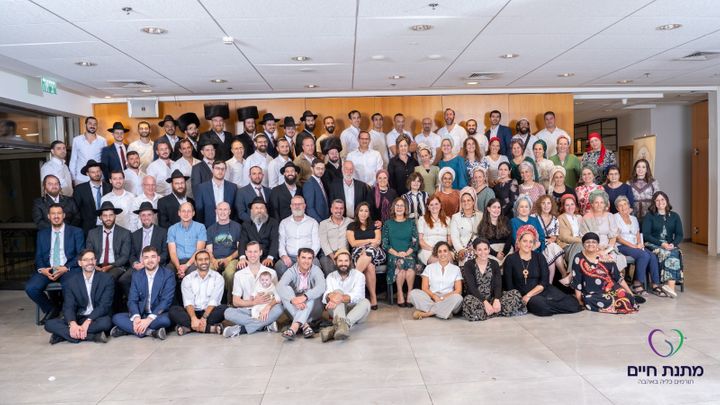
Group shot of Matnat Chaim donors
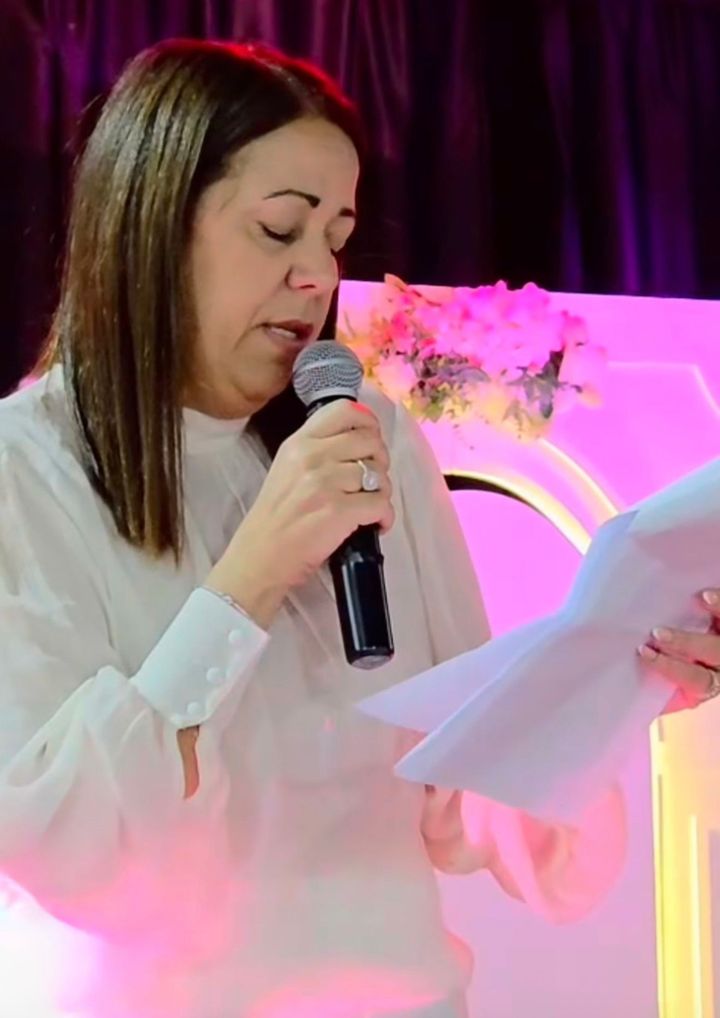
Gal Alush, widow of Dani, z'l